 How-to
How to Troubleshoot Heavy Equipment Engine Fault Codes
Quick Summary
To troubleshoot engine fault codes on heavy equipment, first identify the warning light color and whether it is steady or flashing, then record the code with its DTC, SPN and FMI. Confirm whether the code is active, stored or historical, check basics like fluids, battery and grounds, and only then test the circuit or component against the service specification.
- Red or stop lamps mean shut down safely; amber means plan a repair soon.
- Record the DTC, SPN, FMI, active or stored status, and hour meter before touching anything.
- Check fluids, battery state and ground condition before suspecting electronic components.
- Clear codes only after the repair is complete, then verify they stay clear through a full cycle.
- Escalate to a specialist when a code repeats after repair or a module will not communicate.
Table of Contents
- Understanding Engine Fault Codes and Warning Lights
- How to Read DTC, SPN and FMI Code Formats
- Caterpillar Fault Code Lookup: Retrieving and Verifying Codes
- Heavy Equipment Fault Code Troubleshooting Steps
- ECM Communication Error Causes and Electrical Checks
- Common Engine Fault Codes and Their Likely Causes
- When to Stop Work, Derate Decisions and Escalating to a Specialist
- Frequently Asked Questions
Heavy equipment engine fault codes can stop a machine cold, and most of the time the warning light is the first sign something is wrong. The steps below outline a practical workflow for when a code appears on a machine in the field. We'll cover how fault codes are structured, how to read the DTC, SPN and FMI formats, and how to decide when to keep working and when to stop.

Understanding Engine Fault Codes and Warning Lights
An engine fault code is a stored message that the engine control module (ECM) writes when it detects a reading outside its expected range. The warning light on the dash is simply the signal that a code exists.
Not every light means the same thing. Check the light color and whether it is steady or flashing before doing anything else. Red usually means stop now. Amber usually means the fault needs attention soon.
- Red or stop lamp: shut down safely and investigate before operating.
- Amber or warning lamp: note the code, plan a repair, and watch for derate.
- Flashing lamp: treat as urgent, even if the machine still runs.
Active, Stored and Historical Codes
An active code is present right now. A stored code happened earlier and may still be in memory. A historical code is one that appeared before and was logged but is no longer present. Each type tells you something different, so record which one you see.
How to Read DTC, SPN and FMI Code Formats
Most heavy equipment codes combine three pieces of information:
- DTC (Diagnostic Trouble Code): the code the scan tool displays, often a letter and numbers.
- SPN (Suspect Parameter Number): identifies the component or signal involved.
- FMI (Failure Mode Identifier): describes how the signal failed, such as open circuit, short, or out of range.
Write down all three. An SPN 100 with FMI 3, for example, points to a voltage problem on a specific sensor circuit, which narrows your checks considerably.
Caterpillar Fault Code Lookup: Retrieving and Verifying Codes
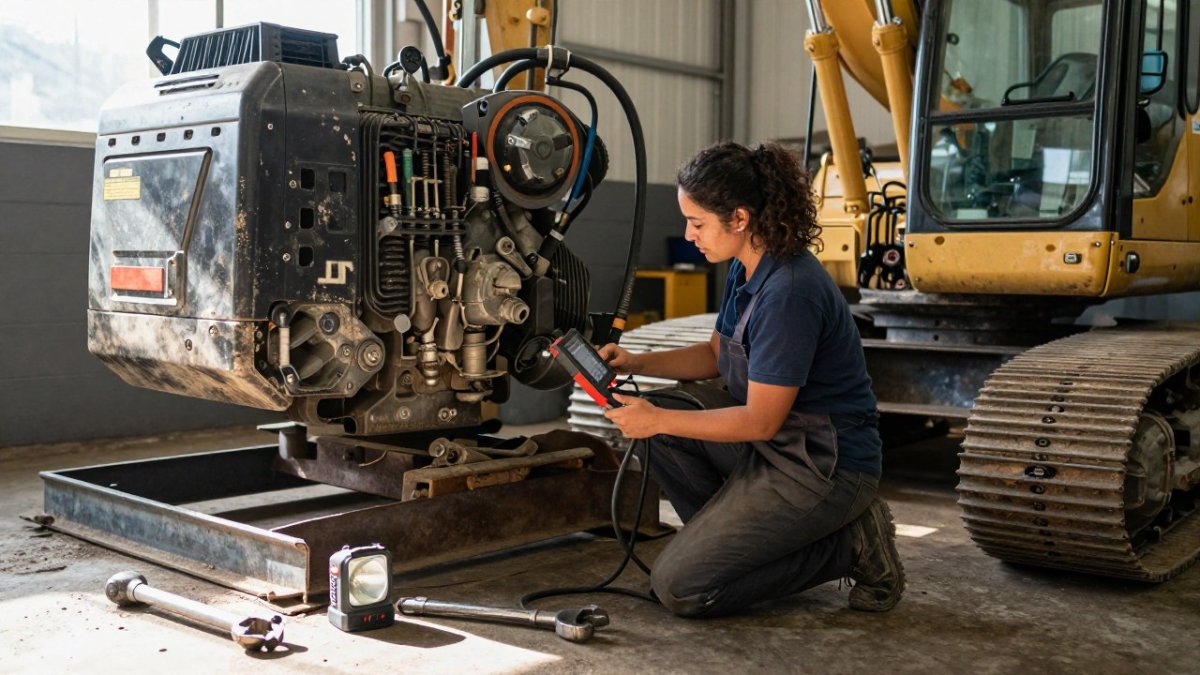
To look up a Caterpillar code, retrieve it through the machine's diagnostic connector with a compatible tool, then match the code against the service documentation for that model and serial number. Confirm the code is current before replacing parts, since stored codes can be old.
Clear codes only after you have recorded them and fixed the cause, then confirm the code does not return during a test run.
Heavy Equipment Fault Code Troubleshooting Steps
Most code lists stop at lookup. A repeatable workflow is what separates a five-minute fix from a second failure in the field. The sequence below is a practical approach for an excavator, loader, or dozer before any part is ordered, built around recording symptoms first so the repair can be verified at the end.
Step 1: Record the symptom and the code before touching anything. Write down the machine model, serial number, hour meter reading, the exact code, the SPN and FMI, whether the code is active or stored, and what the operator was doing when the light came on (load, idle, cold start, after a wash).
Step 2: Classify the code type. Decide whether you are looking at an active fault, a stored or historical fault, or an intermittent one. Active faults are present now and can usually be tested directly.
Step 3: Check the basics before the electronics. Fluid levels, fuel quality and water contamination, air filter restriction, battery state of charge, and ground condition come first. A weak battery or a corroded ground can set sensor and communication codes that look like failed components.
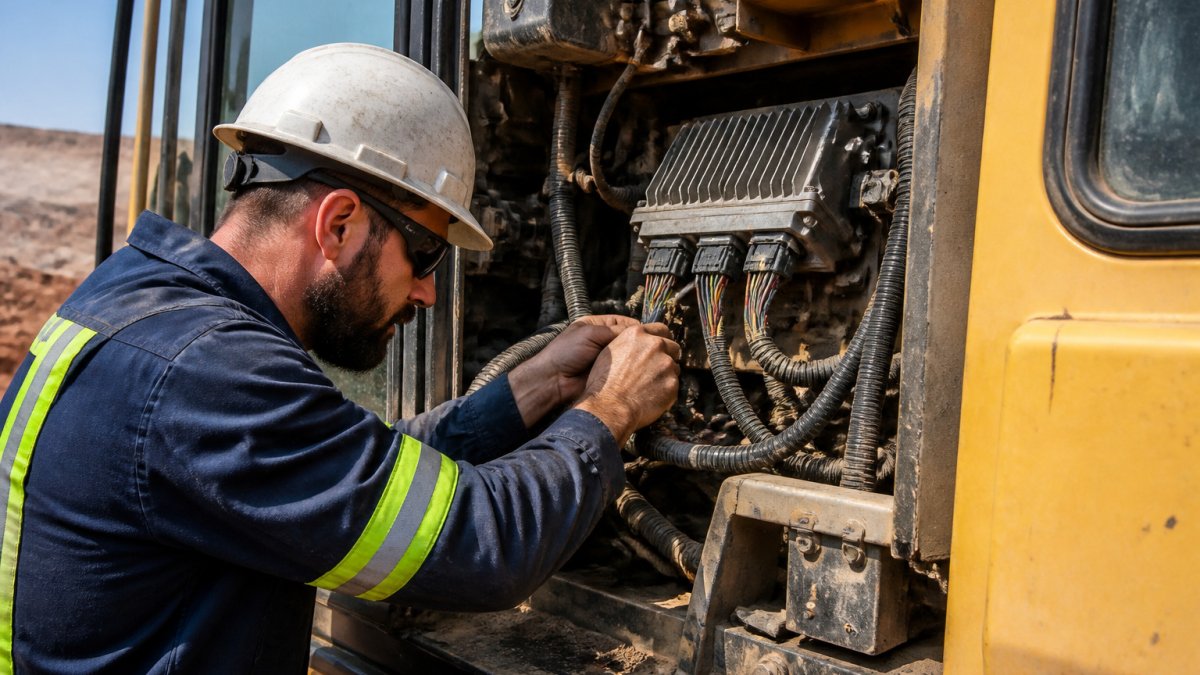
Step 4: Inspect the circuit, not just the sensor. For any sensor or actuator code, inspect the connector for corrosion, pushed-back pins, and chafed wiring along the harness route. Perform a wiggle test on the harness while watching live data; an intermittent code that appears only under vibration usually points to a connection, not a sensor.
Step 5: Test the component against specification. Use the service documentation for that model and serial number to find the expected resistance, voltage, or pressure. Test the component and the circuit separately so you know whether the fault is in the sensor, the wiring, or the ECM.
Step 6: Repair, clear, and verify. Repair the cause, clear the code only after the repair is complete, and run the machine under the same condition that set the original code. Confirm the code stays clear through a full operating cycle, including a load test where safe.
Step 7: Document and escalate if needed. Record what was found, what was replaced, and whether the code recurred. A fault that repeats after a verified repair, a module that will not communicate, or a fault that involves ECM programming is a signal to escalate rather than keep swapping parts.
Clearing a code without fixing the cause can bring it back, sometimes at a worse time.
ECM Communication Error Causes and Electrical Checks
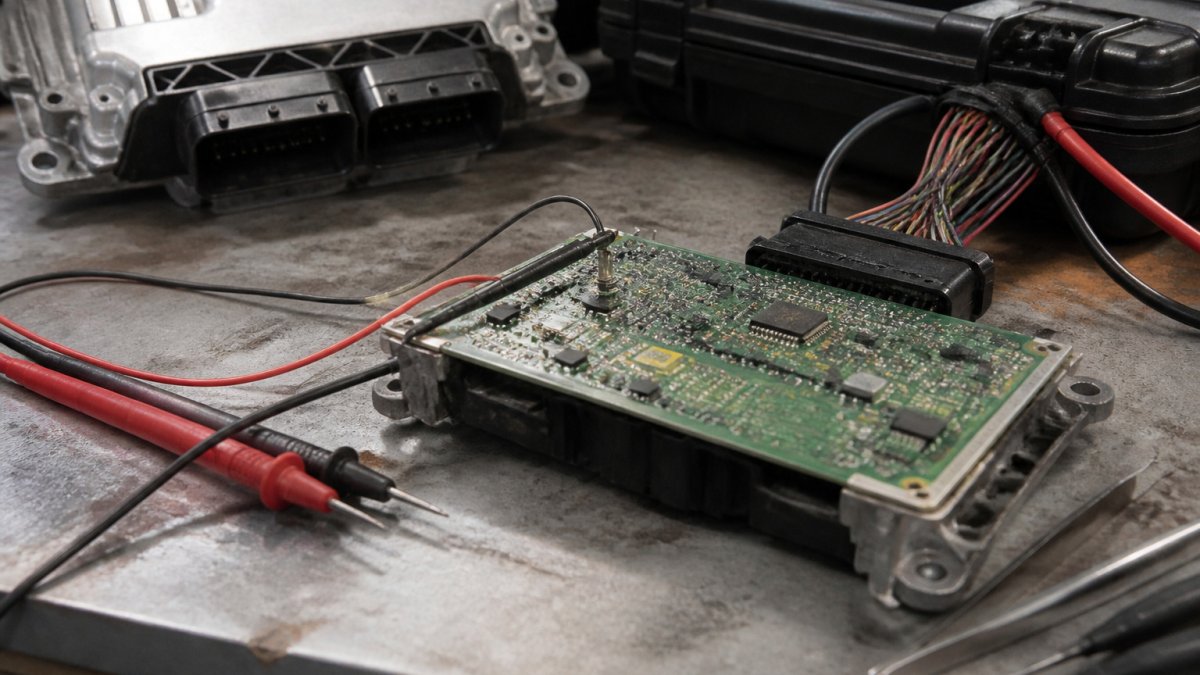
A communication error means the ECM is not talking reliably to other modules. Common causes include a loose connector, a damaged CAN bus wire, a failing module, or a power or ground fault. Check connectors first, then test continuity and resistance across the CAN lines before suspecting the ECM itself.
Bricked or non-responding modules after a failed software update need a controlled recovery process rather than repeated attempts. Our guide on recovering a bricked engine module safely covers that process in more detail.
Common Engine Fault Codes and Their Likely Causes
The table below summarizes common fault patterns on heavy equipment and the checks we usually start with. Treat it as a starting point, not a diagnosis, because the same SPN can mean different things across machine types and control modules.
| Code pattern | Likely area | First check |
|---|---|---|
| Sensor out of range (FMI 3, 4) | Sensor or wiring | Connector, pin tension, and voltage at sensor |
| Fuel pressure fault (SPN 94, 157) | Fuel system | Filter condition, supply pressure, and aeration |
| Communication fault (CAN, J1939) | CAN bus or ECM | Connectors, CAN continuity, and terminating resistance |
| Intermittent code | Loose connection | Wiggle test under load and live data review |
| Aftertreatment fault (DPF, DEF, SCR) | Emissions system | Soot load, DEF quality, and sensor readings |
| Oil pressure fault (SPN 100) | Lubrication | Oil level, sender, and actual pressure with a gauge |
| Coolant temperature fault (SPN 110) | Cooling system | Coolant level, thermostat, and sender resistance |
Engine and fuel-system codes. SPN 100 (oil pressure) and SPN 110 (coolant temperature) are among the most common engine codes. An FMI 3 or 4 on either usually points to a circuit problem rather than a mechanical failure, so check the sender and harness before condemning the engine. Fuel pressure codes often trace to a restricted filter, air in the supply, or a failing lift pump; confirm supply pressure with a gauge rather than trusting the dash reading alone.
Aftertreatment codes. DPF, DEF, and SCR faults are common on Tier 4 and Stage V machines. A derate from an aftertreatment fault can limit power long before the machine stops, so check soot load, DEF quality and concentration, and the relevant sensor readings before assuming the filter needs replacement. Many aftertreatment codes are caused by a sensor or dosing fault, not the filter itself.
Transmission and hydraulic codes. On excavators, loaders, and dozers, codes from the transmission and hydraulic control modules can appear alongside engine codes and are often misattributed to the engine. If the engine derates only under load, check whether a transmission or hydraulic pressure fault is setting first. Record which module set the code, not just the code number.
Communication and electrical codes. CAN bus and module communication faults are frequently caused by a loose connector, a damaged harness, or a power or ground fault rather than a failed ECM. Check terminating resistance and continuity across the CAN lines before replacing a module.
Intermittent and historical codes. An intermittent code that appears only under vibration, temperature change, or a specific load usually points to a connection or a failing sensor on the way out. Historical codes may be old and should not drive parts replacement on their own. Confirm the symptom is still present before acting on a stored code.
Causes depend on the machine, the control module, and the operating conditions, so always confirm the code against the service documentation for that model and serial number before ordering parts.
When to Stop Work, Derate Decisions and Escalating to a Specialist
Stop work immediately for any red warning, smoke, overheating, or loss of steering or braking. Derate, where the machine limits power to protect the engine, is a warning that the problem is getting worse. Keep working only if the machine is safe and the fault is minor and understood.
Call a specialist when the code repeats after repair, when a module will not communicate, or when the fault involves ECM programming. Our overview of how remote ECM programming works explains what a specialist can do from a distance, and reflashing diesel engine modules step by step shows what that process involves before you decide.
If you have a fault that does not fit these patterns, contact Construction Calibrations for a confirmed quote against your exact ECM before anything is shipped or changed.
Stuck on a code that keeps coming back, or a module that will not respond? Construction Calibrations provides diagnosis-led ECM recovery and calibration for heavy equipment fleets. Get a quote and we will confirm the work against your exact module before we start.
Frequently Asked Questions
What are some common heavy equipment engine fault codes?
Common engine fault codes on heavy equipment usually point to sensor, fuel-system or electrical problems rather than a single failed part. Codes tied to fuel pressure, fuel temperature, airflow sensors and sensor voltage are frequent, as are communication faults between control modules. Each code is typically expressed as a DTC, with an SPN identifying the affected component and an FMI describing the failure mode. Always confirm the code against the manufacturer's lookup for your specific machine, because the same number can mean different things across makes and model years.
Can you keep operating heavy equipment with an active engine fault code?
It depends on the code's severity and the machine's protection strategy. Some active codes trigger a warning only, while others cause a derate that limits power or engine speed, or a shutdown to protect the engine. Check the warning light colour and the severity level shown on the display before continuing work. If the machine derates, stops responding or shows a red warning, stop operating it and escalate to a qualified technician rather than trying to override the protection.
How do you tell whether a fault code is active or logged?
An active fault is currently present and typically keeps the warning light on or the machine derated. A logged or stored fault occurred previously and was recorded by the engine control module, but may not be happening now. Historical codes help identify intermittent problems, such as a loose connector or a failing sensor that only misbehaves under vibration or temperature change. Read both active and stored codes with a diagnostic tool, note the operating conditions when they set, and clear codes only after the underlying cause has been repaired and verified.
Can a weak battery cause heavy equipment engine fault codes?
Yes. Low system voltage can cause the engine control module and sensors to behave erratically, which may set voltage-related or communication fault codes that do not reflect a real component failure. Before replacing sensors or modules, measure battery voltage and charging system output with the engine running, and inspect battery terminals and main ground connections for corrosion or looseness. Clear and re-read codes after correcting the power supply to confirm whether the faults return.