 How-to
How to Reflash Diesel Engine Modules: Step-by-Step
Table of Contents
- What Module Reflashing Actually Does Before You Start
- How to Reflash Diesel Engine Modules: Prerequisites and Pre-Flash Checks
- Diesel ECM Bench Programming vs In-Vehicle Flashing
- ECM Flash Tools for Heavy Equipment: What You Need
- ECM Software Backup and Restoration Before Any Write
- Diesel ECM Recovery After a Failed Flash
- Post-Flash Validation, Relearn, and Drive-Cycle Checks
- Conclusion: When to Reflash Yourself and When to Call a Specialist
- Frequently Asked Questions
Last Updated: October 19, 2026
What Module Reflashing Actually Does Before You Start
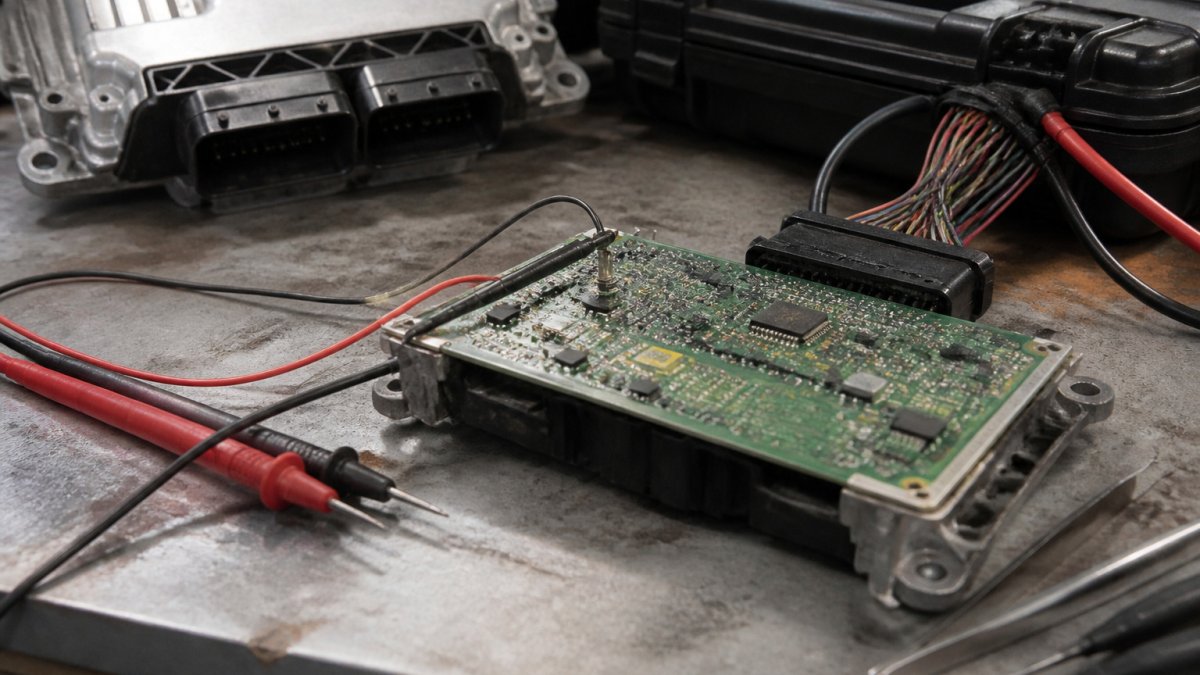
Module reflashing is the process of overwriting the calibration software inside an engine control module (ECM) or powertrain control module (PCM) with a known, correct file. It does not repair hardware. It replaces the instructions the module uses to run the engine.
That distinction matters more than most guides admit. If a module has a burnt driver circuit or a cracked solder joint, no amount of reflashing will save it.
Here's what a reflash actually changes:
- Fuel delivery maps and injection timing
- Turbo boost limits and torque curves
- Idle speed and cold-start behavior
- Transmission communication parameters on shared modules
- Emissions-related calibration values
The engine control module holds two things: firmware (rarely touched) and calibration (routinely replaced). Reflashing targets the calibration layer. That's why a failed flash usually leaves the module recoverable, while a firmware corruption can brick it outright.
Before you touch anything, confirm three facts. Which module are you writing to? Which calibration belongs in it? And do you have a verified backup of what's on it now?
Get any of those wrong and you'll be diagnosing a problem you created.
How to Reflash Diesel Engine Modules: Prerequisites and Pre-Flash Checks
Learning how to reflash diesel engine modules starts with checks, not cables. The most common cause of a failed flash is a voltage drop mid-write, and that's entirely preventable.
Run through this list before every job:
- Battery voltage at or above 12.5V (24V systems: 25V+), confirmed with a multimeter
- Battery charger or power supply connected and stable
- Ignition in the correct key-on position per the service procedure
- All aftermarket accessories disconnected from the diagnostic connector
- VIN, engine size, transmission, and module part number recorded
- Current calibration identifier read and logged
- Diagnostic trouble codes read and cleared, then re-read
- Laptop charged and sleep mode disabled
Record the module part number and calibration identifier before you start. If the flash fails, those numbers are how you find the correct file to restore.
Diesel ECM Bench Programming vs In-Vehicle Flashing
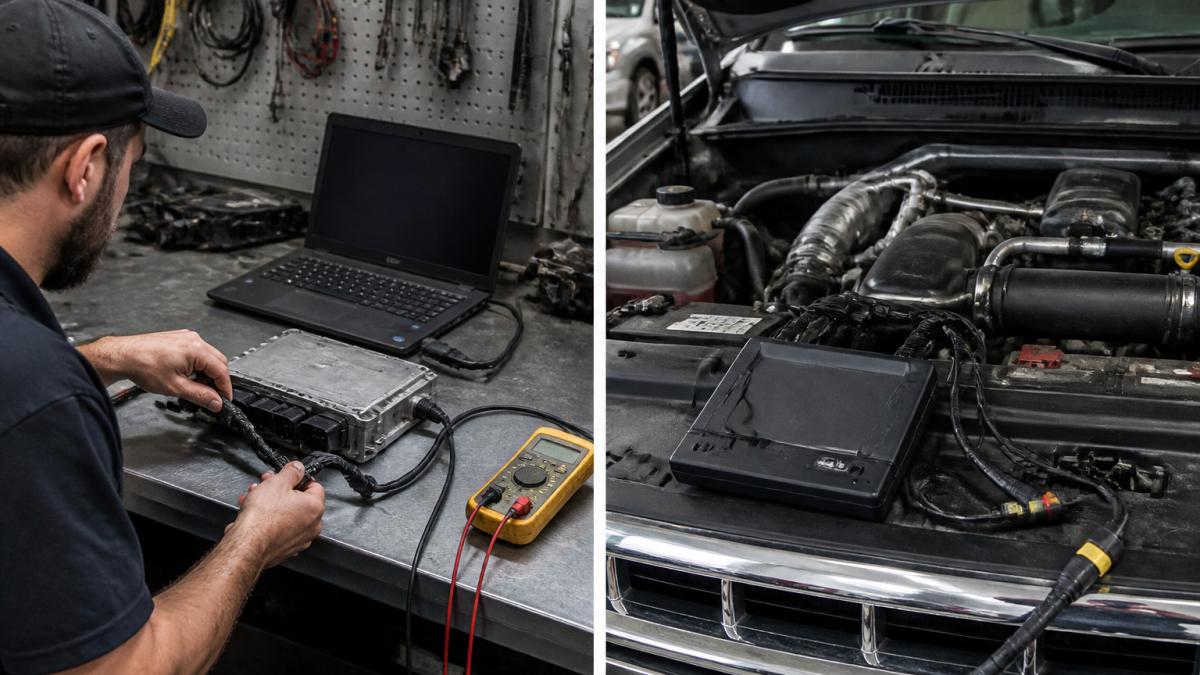
Bench programming means pulling the module and writing to it on a bench harness. In-vehicle flashing happens through the diagnostic connector with the module still in the machine. Both work. They fail differently.
In-vehicle flashing is faster and needs no disassembly. It's the right call for routine software updates and calibration changes on a healthy machine. The catch: you're at the mercy of the vehicle's wiring, voltage stability, and communication link quality.
Bench programming removes those variables. You control power, you control the harness, and you can read the module directly. It's the standard approach for diesel ECM bench programming when a module is bricked, when the machine can't hold stable voltage, or when the diagnostic connector itself is suspect.
| Factor | Bench Programming | In-Vehicle Flashing |
|---|---|---|
| Module removal | Required | Not required |
| Voltage control | Full | Depends on machine |
| Best for | Bricked or non-communicating modules | Routine calibration updates |
| Risk of wiring faults | Low | Higher |
| Downtime | Longer setup, faster recovery | Shorter setup |
A common mistake is trying to flash in-vehicle on a machine with a known charging fault. Fix the charging system first, or go to the bench.
ECM Flash Tools for Heavy Equipment: What You Need
The right ECM flash tools for heavy equipment fall into three groups: the hardware interface, the programming software, and the calibration files themselves. Missing any one of them stops the job.
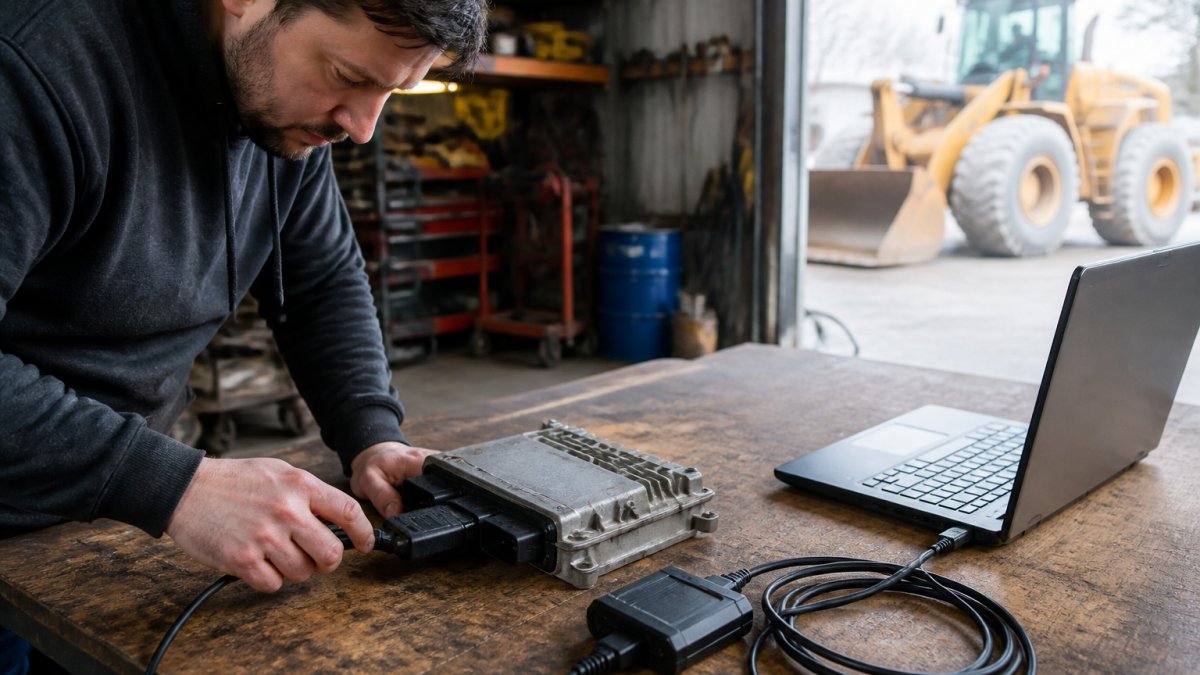
Hardware interface. This is the pass-through device between your laptop and the diagnostic connector. It must support the protocol your machine uses.
Programming software. This does the actual read, calibration swap, and verify step. Some packages are OEM-specific (for example, manufacturer service tools that require a subscription and a licensed vehicle connection); others are multi-brand aftermarket platforms that cover certain modules under license.
Calibration files. This is the layer people underestimate, and it is where diesel work differs most from passenger-car flashing.
For fleets running mixed equipment, keep a written log of which interface, software version, and calibration file worked on which machine. That log saves hours the next time the same model comes through, and it is the fastest way to spot when a tool update has changed supported coverage.
SAE J1939 serial control and communications network standard overview
A final caution on the tools themselves: cheap interfaces that claim multi-protocol support often fail during the write rather than the read, which is the worst possible time. If a job matters, use an interface with a known track record on your specific machine family, and test communication with a read-only session before committing to a write.
ECM Software Backup and Restoration Before Any Write
Back up before you write. No exceptions. ECM software backup and restoration is the difference between a recoverable module and a replacement order, and on diesel equipment it is also your record of the emissions and torque configuration the machine left the factory with.
The read step captures the current calibration and, depending on the tool and module, may also capture adaptation data and fault history. Do this even when the module is running poorly, because you want a record of what was there before you changed anything.
Store backups in three places:
- On the programming laptop
- On a shop server or network drive
- On external media kept with the machine's service records
Name the file with the VIN, engine serial number, ECM part number, calibration identifier, and date. A folder full of files called "backup1" is useless six months later, and on a mixed fleet it is dangerous because the wrong file can look plausible.
Restoration is the reverse: write the saved file back to the module, then verify. This is the standard fix for a module that took a bad calibration, and it is why the backup exists. Two diesel-specific cautions apply.
We back up original software before any change on every job. It is the only way to put a machine back exactly as it left the factory if a customer changes their mind, a calibration does not suit the application, or an emissions inspection requires the stock file.
Diesel ECM Recovery After a Failed Flash
Diesel ECM recovery after a failed flash is usually possible, and it starts with not panicking. A module that won't communicate after an interrupted write is often still alive. It's sitting in a bootloader state waiting for a valid file.
First, confirm the failure mode:
- Does the scan tool see the module at all?
- Does it respond on the bus but refuse to identify?
- Is there any communication, or total silence?
If there's partial communication, try a bench recovery with a stable power supply and a direct harness. Many modules that fail in-vehicle will accept a write on the bench.
If the module is completely silent, recovery depends on whether the bootloader survived. A professional bench recovery can often restore it. Some modules are genuinely beyond saving, usually after a hardware fault rather than a bad flash.
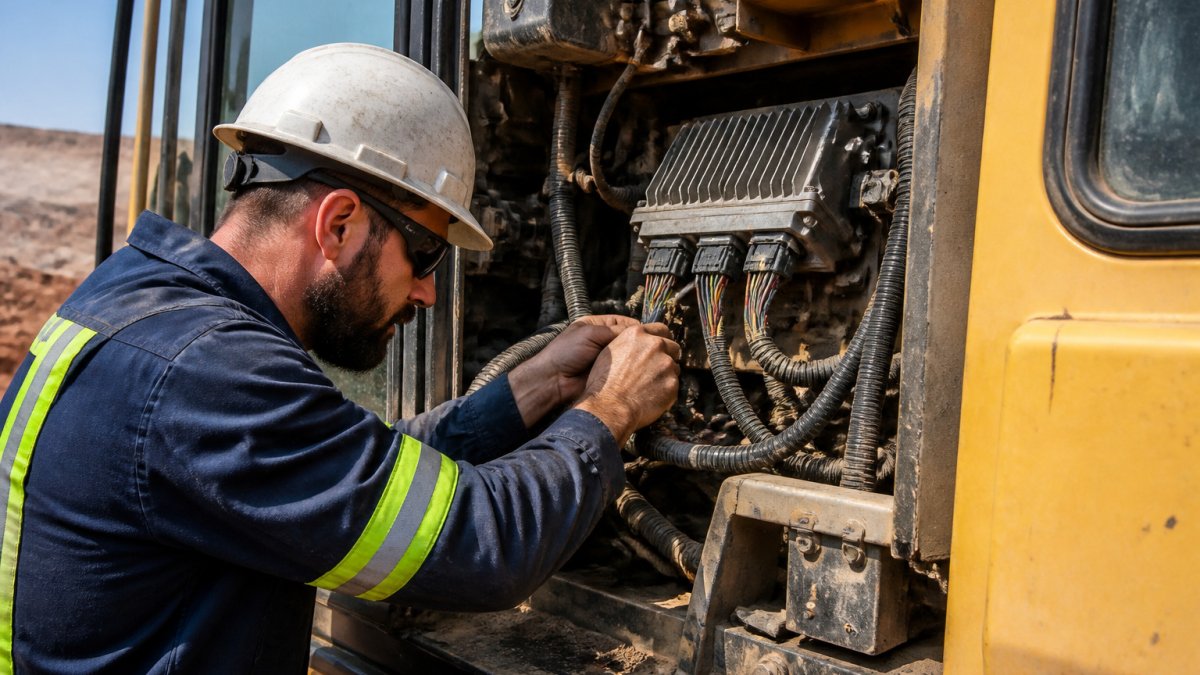
This is where a specialist bench setup earns its keep. Construction Calibrations handles recovery for modules that failed mid-flash or lost their software entirely, including equipment operating far from the home shop.
Post-Flash Validation, Relearn, and Drive-Cycle Checks
The flash isn't finished when the progress bar completes. Validation is the step that proves the job worked.
Start with a verification read. Confirm the calibration identifier now in the module matches the file you intended to write. If it doesn't match, stop and investigate before running the engine.
Then clear codes and run a relearn procedure where the platform requires one. Some modules need an idle relearn, a throttle adaptation, or a transmission relearn before they behave correctly.
Next, a drive cycle:
- Idle for several minutes and watch for faults
- Light-load operation under steady throttle
- Moderate acceleration through the gears
- A full warm-up to operating temperature
- Re-read codes after the cycle completes
Expect some modules to set temporary codes during the first cycle. Clear them and re-check after a second cycle. Persistent codes mean something is wrong with the calibration match, not the flash itself.
Keep an eye on engine performance during the cycle: idle quality, smoke, power delivery, and any derate. A machine that runs clean through a full cycle is done.
Conclusion: When to Reflash Yourself and When to Call a Specialist
The line is clearer than most people think. Routine calibration updates on a healthy machine with stable voltage are reasonable DIY work for a competent technician. Bricked modules, mismatched replacement engines, and equipment spread across multiple states are not.
We built Construction Calibrations around that second category. In diesel tuning since 2012, with thousands of machines programmed, we back up original software before any change and confirm every quote against the exact ECM before shipping. Our bench programming and recovery work covers construction, mining, agricultural, and forestry equipment, with global shipping for fleets operating abroad.
If you're weighing a reflash against a replacement module, get a quote first. Send us the module part number and we'll confirm what's possible before you commit to anything.
Get a quote from Construction Calibrations and get your machine back to work.
Frequently Asked Questions
Can you reflash a diesel ECM without removing it from the machine?
Yes, in-vehicle flashing is common on many heavy equipment platforms, provided the battery is fully charged and the diagnostic connector and communication link are stable. The risk is interruption: a voltage dip or loose cable mid-write can leave the module in a non-communicating state. Bench programming removes that risk because the ECM runs on a controlled power supply. If your machine sits in a remote yard with unreliable power, pulling the module and bench flashing it is often the safer route.
What should you do if an ECM flash fails or is interrupted?
Stop, do not cycle the ignition repeatedly, and do not attempt another write with the same unstable setup. Note the exact error and the point of failure. A failed flash usually leaves the module in boot or recovery mode, which a bench programmer can often recover by writing the original calibration file back. If you backed up the stock software first, recovery is far more likely. If you did not, a specialist with OEM calibration access can usually restore it, but expect more time and cost.
What tools are needed to reprogram a diesel engine module?
You need a compatible scan tool or programming software for that specific ECM family, the correct interface hardware and cables, a stable power supply holding battery voltage during the write, and the factory calibration file matched to the VIN, module part number, and engine size. A multimeter and a record of the original software version help. Many failures trace back to mismatched calibration files or weak power, not the programmer itself, so verify compatibility before you connect anything.
How much does professional diesel ECM reprogramming cost?
Pricing depends on the module, the machine, whether it is a routine calibration update or a recovery job, and whether the work is done remotely or on a bench. A bricked module that needs full software restoration takes more time than a straightforward reflash. Compare that against replacing the ECM outright, which is often far more expensive and still needs programming. Construction Calibrations publishes pricing on its website and confirms quotes against the exact ECM before shipping.