 How-to
Is Diesel ECM Tuning Worth It for Contractors?
Quick Summary
Diesel ECM tuning reprograms the engine control module to change fuel, boost and power behavior, and it can add usable torque on working machines. Whether it is worth it depends on the machine's duty cycle, whether the calibration matches the exact engine, and whether emissions and warranty stay protected.
- Machines in production digging, load-and-carry or grade work benefit most from tuning.
- Track fuel per hour and cycle times before tuning, then repeat the same measures after.
- Confirm the quote is tied to the exact ECM part number and engine family.
- Ask for a backup of original software and confirm emissions and warranty handling first.
- Fuel savings vary widely, so compare your own before-and-after numbers rather than a fixed percentage.
Table of Contents
- What Diesel ECM Tuning Changes on Your Equipment
- Which Construction Machines Benefit Most from Tuning
- Horsepower, Torque, and ECM Tuning Under Load
- Diesel Fuel Economy Tuning: What Realistic Gains Look Like
- Diesel ECM Tuning Cost and How to Compare Quotes
- Emissions Compliance, Warranty, and Legal Risks
- Booking Your First Tune: Checklist for Contractors
- Frequently Asked Questions
What Diesel ECM Tuning Changes on Your Equipment
Last Updated: November 17, 2026
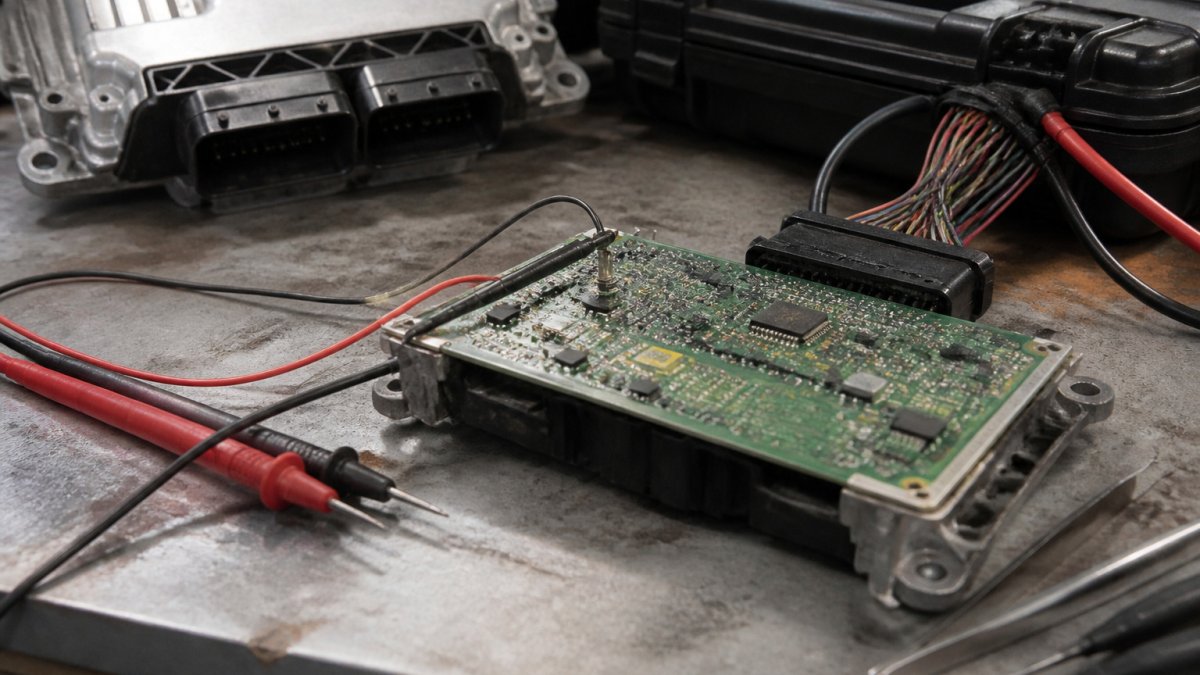
Diesel ECM tuning means reprogramming the engine control module, the computer that sets fuel timing, fuel quantity, boost and other engine parameters.
Diesel ECM tuning is the process of changing the calibration software inside the engine control module so the engine runs with different fuel and air settings.
Tuning changes the software, not the hardware. A calibration can only work within what the engine, turbo, injectors and emissions equipment were built to handle.
Some providers present tuning as a fuel-and-air calibration rather than a fuel-only change. Banks Power states that fuel-only tuning can raise exhaust-gas temperature quickly and cause the ECM to cut fuel, and describes its approach as managing fuel and air together.
What typically changes after a tune:
- Fuel delivery and timing, which affects power and how the engine responds to the throttle
- Boost targets and air management, which determine how much air the turbo pushes into the engine
- Rev limits, torque curves and load response, which change how the machine feels during digging or hauling
- Emissions-related parameters, which must be handled carefully to stay legal and avoid fault codes
Watch out: A tune that adds fuel without matching the engine's hardware can cause overheating or damage. Confirm with the provider that the calibration fits your exact engine family and configuration before it is written to the module.
Before you commit to a tune, you should know what it changes, what it leaves alone and what the provider will document.
Which Construction Machines Benefit Most from Tuning
Machines that work hard at a steady load usually show the clearest benefit, but the practical question for a contractor is which machine on the lot to tune first.
A useful way to sort candidates is by duty cycle rather than by equipment category. The descriptions below are patterns most practitioners report, not guarantees for any specific machine.
Excavators in production digging. Machines that hold a load through a full bucket cycle in dense material, trench through rock, or run a breaker for hours are the strongest candidates.
Dozers pushing grade. Grading and bulk pushing reward mid-range torque and steady power under load.
Skid steers and compact track loaders in intermittent work. These machines cycle constantly: dig, lift, dump, return.
Motor graders, scrapers, and specialty machines. These sit between the categories above. The deciding factor is whether the machine is held at a sustained load or cycles quickly.
Before choosing, match the tune to how the machine is actually worked, not to a generic power number.
Pay attention to the engine family and configuration more than the machine name. To check whether your machine is covered, see the John Deere construction equipment page for that equipment class. If you run Mercedes-Benz trucks alongside your machines, the Mercedes-Benz Trucks page lists the models that are offered.
Watch out: a machine that is already at its drivetrain or cooling limit will not benefit from more torque, and may be damaged by it.
Horsepower, Torque, and ECM Tuning Under Load
Horsepower and torque matter differently on a jobsite. Torque is what lets an engine pull a loaded bucket through hard ground, while horsepower governs how fast that work gets done. A tune that raises torque in the mid-range often makes a machine feel stronger when it digs or climbs, even if peak numbers change little.
Gains depend on the engine and the duty cycle. Tuning claims are only useful when the provider can show the setup behind them. Treat any figure without a test method and baseline as marketing rather than measurement.
Measure performance under load, not just at idle or on a dyno. Note how long a standard cycle takes before and after the tune, and whether the engine lugs down less on the same material. Record fuel use across the same shifts so the comparison is fair.
Diesel Fuel Economy Tuning: What Realistic Gains Look Like
Fuel economy tuning aims to burn less fuel for the same work. Gains come from matching fuel delivery to real load, not from simply running the engine leaner. Fuel-economy results vary widely by machine, job and operator, so no single percentage applies to every fleet.
Be cautious of any promise of a fixed saving. Tuning cannot change how the machine is operated, how often it idles, or whether it is maintained. Dirty filters, worn injectors and poor air supply will erase gains that a calibration might otherwise deliver.
For a broader view of fuel and uptime trade-offs, read Heavy Equipment Engine Tuning: Fuel, Power and Uptime Benefits and compare fuel-efficient options in Fuel Efficient Heavy Equipment Rental Options Compared.
Track fuel per hour, per cubic yard or per ton before tuning, then repeat the same measure afterward. A short trial on one machine tells you more than a brochure figure.
The article notes that realistic fuel-economy results vary widely, so compare your own before-and-after numbers rather than a fixed saving.
| Measure | How to track it | Why it matters |
|---|---|---|
| Fuel per hour | Record before the tune | Sets the baseline for comparison |
| Fuel per cubic yard or ton | Use the same shifts after the tune | Ties fuel use to real output |
| Cycle times | Time a standard cycle before and after | Shows whether work gets done faster |
| Maintenance condition | Check filters, injectors and air supply | Dirty parts erase tuning gains |
Diesel ECM Tuning Cost and How to Compare Quotes
Pricing for diesel ECM tuning depends on the engine, the calibration scope, whether the work is remote or on-site, and how many modules you need. Current pricing is available on the Construction Calibrations website, and a confirmed quote is issued against your exact ECM. That is normal for this market, which means the contractor's job is to make quotes comparable rather than to hunt for a single headline number.
What actually drives the price. Most quotes move on four inputs:
- Engine family and ECM part number. A calibration is written for a specific ECM and engine configuration. A quote that is not tied to the exact part number is not a real quote.
- Calibration scope. A single economy or tow calibration is different work from a multi-stage set with switchable power levels, and the price reflects that.
- Service mode. Remote or ship-in service is usually less expensive than on-site work, because on-site adds travel and scheduling. Fleets spread across several states often use remote service for that reason.
- Module count and recovery risk. Tuning several machines, or a module that needs recovery work, changes the scope. Ask what happens if a flash fails and whether recovery is included.
How to compare quotes fairly. Ask every provider the same questions and write the answers down:
- Is the quote tied to the exact ECM part number and engine, not a generic model?
- Will the original software be backed up before any change, and will you receive that backup?
- What is included: calibration, shipping, recovery work, and follow-up support?
- What is the turnaround time, and what happens if a module fails during the flash?
- Does the calibration leave the emissions system intact, and how is warranty handled?
A quote that answers all five is comparable. A quote that answers two is a starting point for a conversation, not a decision.
A practical comparison workflow. Start with a baseline: record fuel per hour, per cubic yard, or per ton, and note cycle times on the same shifts. Get quotes tied to the exact ECM. Choose the provider that documents the calibration logic and the backup process, not just the lowest number. After the tune, repeat the same measurements on the same shifts.
Watch out: a price that looks low because the quote is generic, or because backup and recovery are excluded, often costs more once a module fails or a calibration does not match the machine. Compare scope, not just the number.
Emissions Compliance, Warranty, and Legal Risks
Emissions rules and warranty terms are the areas where a poor tune can cost the most. Goldfarb Inc. warns that incorrect tuning can cause catastrophic engine damage, void warranties and lead to EPA violations, and it does not quantify how often those outcomes occur Goldfarb Inc. guide to diesel ECM tuning risks. Fleet Maintenance notes that tunes are restricted so the engine keeps the right match of pistons, cam, turbo and fuel system to meet EPA and warranty requirements Fleet Maintenance diesel tuning overview.
Confirm that the calibration leaves the emissions system intact and check the warranty position with your equipment dealer before you proceed.
A module that fails during a flash can be recovered in some cases. For that scenario, see How to Recover a Bricked Engine Module Safely.
Booking Your First Tune: Checklist for Contractors
Use this checklist before you send a module or book a service:

- Record the machine make, model, serial number and engine family
- Note the duty cycle and the job the machine does most
- Get current fuel use and a short performance baseline
- Confirm a backup of original software will be made
- Get a quote tied to the exact ECM part number
- Ask how emissions and warranty are handled
- Agree on turnaround time and recovery steps if a flash fails
- Plan a before-and-after comparison on the same shifts
A contractor in a hard hat reviewing a printed service checklist beside a parked excavator at a jobsite is the kind of setup where this list earns its keep.
Construction Calibrations supports remote calibration for fleets spread across several states. Get a quote to see the cost for your machine, and start the process with a clear baseline.
Diesel ECM tuning is worth considering when a machine is underpowered on demanding work and the provider can document a suitable calibration, a backup and a warranty position. Construction Calibrations, with its roots in diesel mechanics since 2012, can quote your exact module before any work begins. Get a quote from Construction Calibrations to check your machine and fleet needs.
Frequently Asked Questions
Is diesel ECM tuning legal for contractors?
Legality depends on what the tune changes and where the machine operates. Tunes that remove or disable emissions controls such as DPF, EGR or SCR systems are generally illegal for road and off-road use in many jurisdictions, and can expose owners to regulatory penalties. Some providers offer calibrations that keep emissions hardware fully functional. Ask any provider to confirm in writing that the calibration keeps the original emissions equipment operating, and check the rules that apply in your state or country before you proceed.
How much does diesel ECM tuning cost?
Pricing depends on the engine, the module, the type of calibration and whether the work is done remotely or by shipping the ECM. Construction Calibrations does not publish fixed price ranges in this article, so the reliable way to compare is to request a confirmed quote against your exact ECM part number before shipping. Compare the quote against the cost of a replacement module, which can be considerably higher.
Can ECM tuning improve fuel economy in construction equipment?
A well-matched calibration can improve fuel use, but results vary widely by machine, duty cycle and operator habits. Fuel gains usually come from better fuel and air coordination and from matching the calibration to the actual work, such as heavy digging versus light hauling. Measure fuel burn over comparable shifts before and after tuning so you have real numbers for your fleet rather than relying on general claims.
How can contractors tell whether a machine is suitable for ECM tuning?
Start with the machine's age, engine condition and maintenance history. Confirm that the engine, turbo, fuel system and emissions hardware are working correctly, because a tune cannot fix a worn or faulty component and may stress it further. Check for active diagnostic codes and clear them only after the cause is found. Share the exact engine make, model and ECM part number with the provider so they can confirm compatibility before any work begins.