 How-to
5 Steps to Recover a Bricked ECM on Heavy Equipment
Last Updated: October 26, 2026
Quick Summary
Bricked ECM recovery is possible when the module still communicates with a scan tool through reflashing, but bench programming becomes necessary when standard OBD communication fails completely. Physical damage, water damage, or multiple failed recovery attempts may make replacement more cost-effective than recovery.
- A bricked ECM loses ability to communicate with equipment, shown by no-start conditions and scan tool errors
- Common causes include dead battery during programming, loose connections, wrong file flashed, or interrupted write cycles
- Reflash recovery works if the module communicates; bench programming is needed when OBD communication fails
- Recovery is not worth pursuing if the module has physical damage, replacement is affordable, or downtime cost exceeds recovery cost
- Bench programming turnaround is typically 3-7 days versus 1-2 hours for calibration-only reflash
Table of Contents
- What a Bricked ECM Means and Why It Happens
- Diagnosing a Bricked ECM: The Decision Tree
- Troubleshooting Heavy Equipment ECM Communication Error
- ECM Reflash After Failed Programming
- ECM Bench Programming for Module Recovery
- ECM Repair vs Replacement: Cost, Time, and Risk
- Getting Your Equipment Running Again
- Frequently Asked Questions
What a Bricked ECM Means and Why It Happens
A bricked ECM is an engine control module that has lost its ability to communicate with your vehicle or equipment.
Common symptoms of a bricked module
Signs can include the equipment not starting, dash lights coming on without a response, scan tools showing no communication, and reflash attempts timing out or failing.
You might also see:
- No power to the ECM or partial power only
- Fan spins but engine won't crank
- All electrical systems work except engine control
- Programming tool can't establish a connection
- Module shows as "unknown" or "not detected"
Failure causes during flash and reflash
A bricked ECM can happen during a flash or reflash, for example if power cuts out, the cable disconnects, the tool crashes, or the file is incompatible.
Common causes include:
- Dead or weak battery during programming (voltage drops mid-write)
- Loose connections on the bench harness or OBD port
- Wrong file flashed to the wrong module type
- Tool timeout when the module doesn't respond fast enough
- Interrupted write cycle before the bootloader finished
- Corrupted bootloader from a previous failed attempt
Diagnosing a Bricked ECM: The Decision Tree
A systematic diagnostic approach saves you from chasing the wrong fix.
Battery voltage and power supply checks
Check power first.
Watch for these red flags:
- Voltage fluctuates during the connection attempt
- Power drops when the scan tool tries to communicate
- Battery voltage is below 12V
- Bench harness is loose or corroded at the battery terminals
Fuse and connection verification
Inspect the connectors:
- ECM connector pins for corrosion or bent pins
- Bench harness connections for loose or disconnected wires
- OBD port for bent pins or debris
- Ground connections from the ECM to the chassis
Scan tool communication testing
If communication is still zero after these steps, bench programming may be your only recovery option.
Troubleshooting Heavy Equipment ECM Communication Error
Communication errors are the gateway symptom: the module is there but won't talk.
No-start and no-communication scenarios
If battery voltage, fuses, and connectors check out and you still have no communication, you're likely dealing with corrupted firmware or a bootloader failure.
Timeout errors and write failures
If timeouts keep happening, the module may need bench programming with direct bootloader access. Standard OBD reflash won't work.
ECM Reflash After Failed Programming
If your module still communicates with a scan tool, a reflash can restore it.
Calibration-only versus full reflash options
Here's the decision:
- Module communicates, won't start or runs rough → try calibration-only first
- Module communicates but has errors or warnings → try calibration-only first
- Module communicates but previous reflash failed → try full reflash
- Multiple failed attempts → bench programming may be necessary
Preparation and risk controls before reflashing
Plan for interruption. Know what you'll do if power fails mid-write: bench programming setup, replacement module, or a professional recovery service on standby.
ECM Bench Programming for Module Recovery
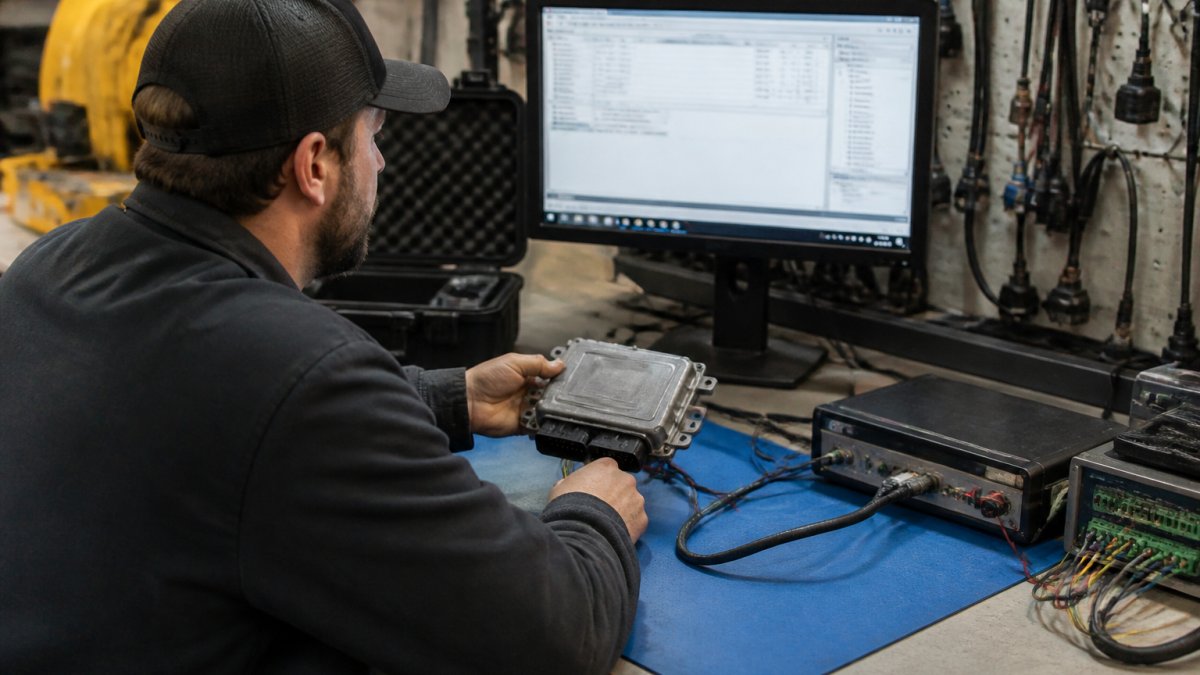
When standard reflash fails, bench programming is often your last chance to recover a bricked module.
When bench recovery is your best option
This is where professional recovery services earn their value. At Construction Calibrations, we maintain bench programming setups for thousands of module types across heavy equipment and can often recover modules that appear completely dead.
File compatibility and module identification
If you're not 100% certain on the file match, stop. A wrong file wipes out the module. Professional recovery services verify this step multiple times before writing anything.
ECM Repair vs Replacement: Cost, Time, and Risk
At some point you need a business decision: recover or replace?
When recovery is possible and worth pursuing
Recovery is NOT worth pursuing when:
- The module is physically damaged (burned components, water damage)
- Replacement is readily available and affordable
- Recovery attempts have already failed multiple times
- Downtime cost exceeds recovery cost
VIN, security code, and immobilizer considerations
Moving a recovered module to different equipment requires reprogramming the VIN and security codes to match the new machine, specialized software and expertise required.
Turnaround time and total cost comparison
Construction Calibrations provides confirmed quotes against the exact ECM before shipping.
Getting Your Equipment Running Again
Construction Calibrations has thousands of machines programmed and provides ECM tuning, reflashing, and recovery services for heavy equipment across construction, mining, agricultural, and forestry sectors. Original software is backed up before any change, and confirmed quotes are provided against the exact ECM before shipping.
Whether your fleet operates locally in the United States or internationally, get a quote from Construction Calibrations.
| Recovery Method | Best For | Typical Turnaround | Complexity |
|---|---|---|---|
| Calibration-only reflash | Module communicates, won't start | 1-2 hours | Low |
| Full reflash | Firmware corruption suspected | 2-4 hours | Medium |
| Bench programming | No OBD communication | 3-7 days | High |
| Module replacement | Physical damage, recovery failed | 1-4 weeks | Low |
| Diagnostic Step | What to Check | Pass Indicator | Fail Indicator |
|---|---|---|---|
| Battery voltage | Multimeter at battery terminals | 12.5V or higher | Below 12V |
| ECM power supply | Voltage at ECM connector | Stable 12V | Fluctuating or low |
| Fuses | Main ECM and control fuses | All intact, correct amperage | Blown or missing |
| Connectors | ECM and OBD port pins | Clean, tight, no corrosion | Corroded, loose, or bent |
| Scan tool communication | Tool connects to module | Module detected, responds | "No communication" error |
Frequently Asked Questions
Can a bricked ECM be recovered?
Recovery is often possible, but it depends on the failure cause, whether a backup exists, and the module's physical condition. A corrupted bootloader may require replacement rather than recovery. If the ECM has communication with a scan tool or programming device, bench programming or a full reflash can restore function in many cases. When a backup was created before the failed write, recovery success rates improve significantly. Professional assessment is essential to determine if your specific module is recoverable.
What causes an ECM to become bricked during programming?
Bricking occurs during flash or reflash when the write process fails, typically due to power loss, interrupted communication, incorrect file compatibility, or timeout errors. A failed write leaves the module in an incomplete or corrupted state, unable to boot or communicate. Battery voltage drops, loose connections, blown fuses, and incompatible calibration files are common culprits. Using an incorrect stock file or programming tool for your specific module type increases risk. Proper preparation, verified power supply, confirmed file compatibility, and module identification, prevents most write failures.
What should I check first if my heavy equipment ECM won't communicate?
Start with battery voltage (must be stable, typically 12-14V for diesel equipment), then check fuses and all connections to the ECM and programming harness. Loose or corroded terminals block communication immediately. Verify your scan tool or programming device is compatible with your module type and vehicle configuration. If voltage and connections are solid but communication still fails, the module may be bricked and require bench programming or professional recovery. Document any symptoms, no-start, timeout errors, or specific fault codes, to help technicians diagnose the failure.
How long does ECM recovery typically take?
Bench recovery or reflashing usually takes 1-3 days, depending on module type, programming tool availability, and whether a backup file exists. Remote calibration services may take 2-5 business days including shipping and confirmation testing. If the module requires replacement due to a corrupted bootloader or permanent damage, lead time depends on parts availability for your specific equipment model. Turnaround improves when you have the original software backed up before failure and can confirm your module identification and vehicle configuration upfront.